%20(2).png)
.png)
.png)
.png)
.png)
.png)
.png)
The Rise of the "Experience Economy" - Why Creators Are Taking Their Communities Offline


For years, creators have been told that the future is digital.
Build your following. Grow your platform. Post consistently. Optimize your content. Create a personal brand. Learn the algorithm.
And none of that is necessarily bad advice.
The internet has completely transformed what it means to be a creator. A musician can release an album without a record label. An illustrator can sell prints to someone across the country. A filmmaker can build an audience without a studio. A chef can turn recipes into a personal brand. A designer can launch a clothing line from their bedroom.
But something interesting is beginning to happen.
After years of moving more and more of our creative lives onto screens, people seem to be craving something incredibly simple:
Real experiences with real people.
We May Be Entering the “Experience Economy”
Eventbrite's 2026 Social Study described an emerging cultural shift as a “Reset to Real.” According to the company's research, 79% of surveyed 18-to-35-year-olds planned to attend more events in 2026.
People aren't necessarily abandoning technology. Instead, many seem to be looking for experiences technology can't completely recreate: spontaneity, presence, participation and genuine human interaction.
And creators are beginning to recognize the opportunity.
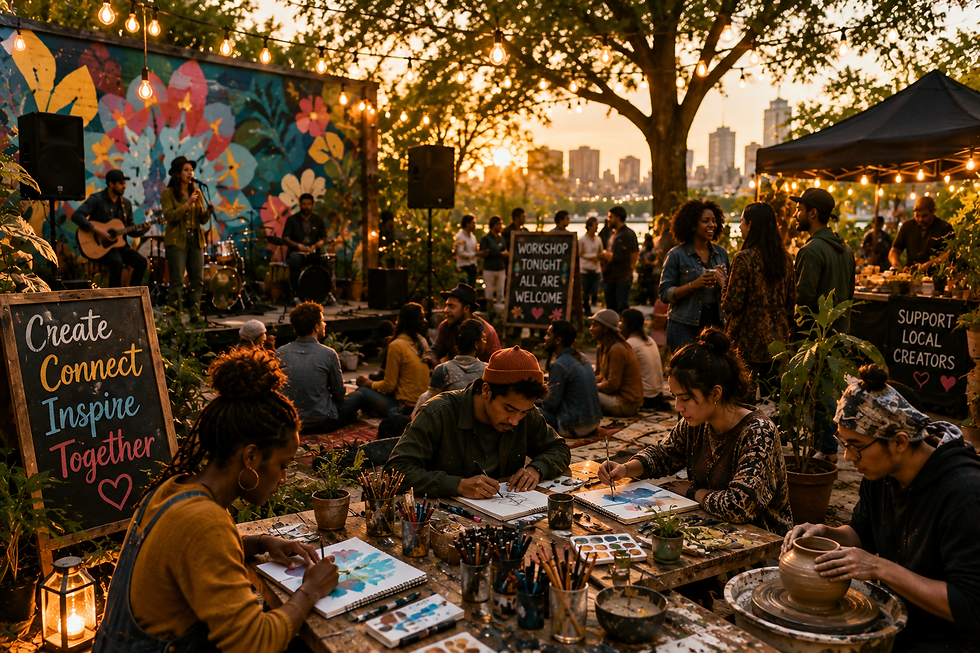
We're seeing creators organize pop-up shops, workshops, listening parties, meetups, art shows, craft nights, live performances, classes and other experiences that allow their audiences to participate instead of simply watch.
That difference matters.
There is a major psychological difference between someone following your work and someone experiencing your work.
Analog Creativity Is Having a Moment
The movement isn't limited to events.
Creative hobbies that require us to physically make something are experiencing renewed interest.
Michaels' 2026 Creativity Trend Report found that searches surrounding analog hobbies—including painting, journaling, knitting, embroidery and crochet—had increased significantly. Searches related to creative social gatherings such as craft nights increased as well.
Even something as seemingly old-school as junk journaling has become increasingly popular.
Why?
Maybe because we've reached a point where doing something with our hands feels refreshing.
When so much of our day consists of tapping, scrolling, typing and swiping, there's something satisfying about picking up a paintbrush, playing an instrument, cutting paper, sewing fabric, molding clay, cooking food or building something physical.
The imperfections become part of the experience.
You don't press “undo.”
You adapt.
And adaptation itself is an act of creativity.
Social Media Gave Us Audiences. Now We Need Community.
This may be one of the biggest opportunities for creators moving forward.
The internet taught us how to accumulate followers.
But followers and community aren't necessarily the same thing.
You can have 100,000 followers and still feel disconnected from the people consuming your work.
Someone might watch your video for seven seconds, tap like and never think about it again.
Compare that with 30 people attending your workshop.
They meet you.
They meet each other.
They learn something.
They laugh.
They create.
They leave with a memory.
That experience can potentially create a much stronger relationship than thousands of passive impressions on a social media platform.
Creators shouldn't necessarily stop building audiences.
We should start thinking about how we can turn audiences into communities.
Every Creative Industry Can Participate
This movement isn't exclusive to musicians or traditional artists.
Almost every creative industry can create experiences.
A painter can organize a community painting night.
A musician can host an intimate listening session.
A producer can hold a beat-making workshop.
A photographer can organize a photography walk.
A filmmaker can host an independent screening.
A chef can create a themed dining experience.
A fashion designer can organize a pop-up showcase.
A writer can create a reading circle.
A DJ can host a themed dance experience.
A graphic designer can teach a branding workshop.
Creators from completely different industries can even collaborate to create experiences that wouldn't exist otherwise.
Imagine a local event combining painters, musicians, chefs, photographers, designers, vendors and performers.
Now creativity isn't simply something being displayed.
Creativity becomes the environment itself.
Stop Thinking Only in Terms of Content
One of the biggest mindset shifts creators can make is asking a different question.
Instead of always asking:
“What should I post?”
Try asking:
“What could I create for people to experience?”
That single question opens an entirely different world of possibilities.
Your creative career doesn't have to exist entirely inside Instagram, TikTok, YouTube, Spotify or whatever platform becomes popular next.
Your social media presence can become the doorway rather than the destination.
Use digital platforms to introduce people to your world.
Then find creative ways to invite them deeper into it.
Creativity Has Always Been Social
Long before social media existed, creativity brought people together.
Humans gathered around music.
We danced.
We told stories.
We painted.
We cooked together.
We celebrated.
We built things.
We passed creative knowledge from one generation to another.
Technology didn't create creative communities.
It simply gave creative communities another place to exist.
And perhaps the next chapter isn't about choosing between digital and physical creativity.
It's about combining them.
A creator might discover someone through social media, invite them to a physical experience, continue that relationship through an online community and eventually bring everyone together again.
Online → Offline → Online.
Instead of competing with technology, real-world creativity can work alongside it.
The Opportunity for Creators Is Bigger Than Followers
Creators have spent years trying to become better at capturing attention.
But attention isn't necessarily connection.
And connection may become increasingly valuable in a world where we're constantly surrounded by content.
The creators who thrive in the future may not simply be the people capable of producing the most content.
They may be the people capable of creating places, experiences and communities where people actually feel something.
So maybe the next creative revolution isn't another app.
Maybe it's a room.
A studio.
A park.
A gallery.
A classroom.
A café.
A festival.
A table surrounded by people making something together.
We've spent years building digital audiences.
Maybe it's time we brought creativity back into the real world.



Comments