


Universal Music Group Sues DistroKid: AI-Generated Music, Copyright Infringement, and the Future of Independent Music

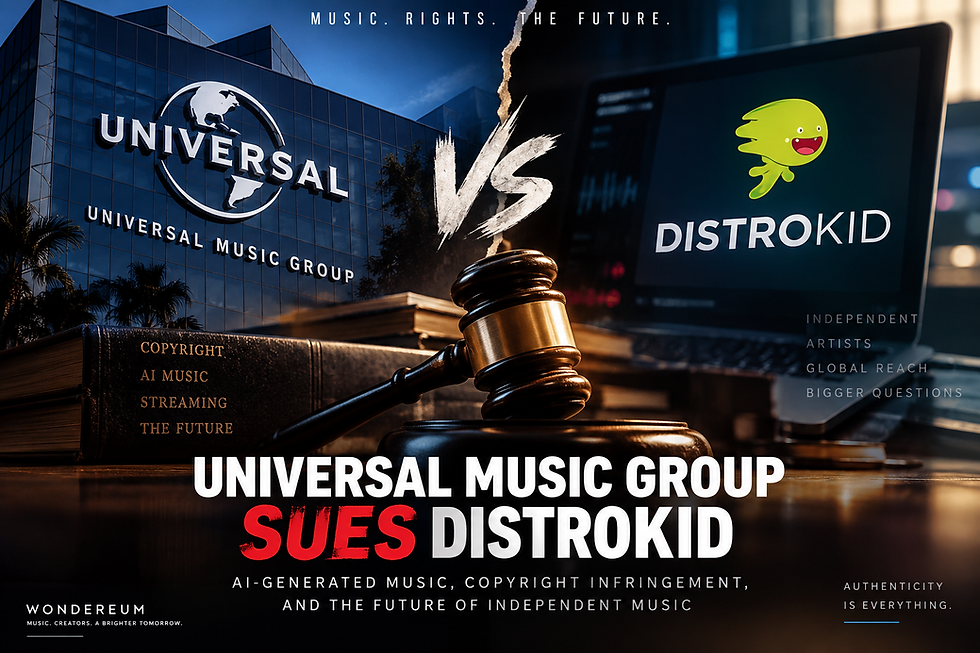
The music industry is facing another major legal confrontation, and this time, one of the world's largest record companies is taking aim at a platform that millions of independent musicians rely on.
On September 15, 2026, Universal Music Group (UMG), through several of its record labels, filed a federal lawsuit against digital music distributor DistroKid, accusing the company of copyright infringement, deceptive trade practices, and facilitating the distribution of massive quantities of AI-generated music.
The lawsuit was filed in the U.S. District Court for the District of Delaware. It names DistroKid LLC and two related companies as defendants, with UMG Recordings, Capitol Records, and Capitol CMG listed as plaintiffs.
But this legal battle raises a question that extends far beyond these two companies:
As artificial intelligence makes music creation and distribution easier than ever, who is responsible for protecting the integrity of the music industry?
Why is Universal Music Group suing DistroKid?
Universal's complaint centers on two major accusations: copyright infringement and deceptive business practices.
The record company alleges that DistroKid has distributed thousands of unauthorized recordings, including altered versions of copyrighted songs, unlicensed remixes, and other material that allegedly exploits Universal's intellectual property.
According to Reuters, the complaint identifies recordings associated with major artists, including The Beatles, Drake, Lady Gaga, and Rihanna.
Universal also alleges that DistroKid allows large quantities of AI-generated content to enter streaming platforms while presenting itself as a distributor of legitimate, artist-backed releases.
The company argues that this practice can divert listeners and streaming revenue away from legitimate artists and copyright holders.
However, these remain allegations. DistroKid disputes Universal's claims, and the lawsuit has not established that the distributor committed the alleged violations.
The controversy surrounding AI-generated music
Artificial intelligence is becoming increasingly accessible to musicians, producers, and everyday creators.
Tools can now generate instrumental compositions, synthetic vocals, and complete songs from relatively simple instructions.
While these technologies offer new creative possibilities, they also create opportunities for mass-produced content, unauthorized imitation, and copyright infringement.
Universal's complaint specifically describes an environment in which enormous quantities of AI-generated music can enter streaming platforms and compete with music created by human artists.
One example highlighted in reporting on the lawsuit involves an account called Lofi Chill, which Universal alleges released 4,562 tracks in a single year. The company uses this example to illustrate its concerns about automated, high-volume music distribution.
But there is an important distinction.
Universal is not arguing that every AI-generated song is inherently illegal.
The complaint distinguishes clearly disclosed AI-generated music from allegedly misleading distribution practices, copyright infringement, and content presented in ways that misrepresent its origins.
In other words, the dispute is not simply about whether artificial intelligence should be allowed in music.
It is about ownership, transparency, authorization, and accountability.
Copyright infringement goes beyond artificial intelligence
Although AI is attracting much of the attention surrounding the lawsuit, the copyright allegations involve more traditional forms of infringement as well.
Universal claims DistroKid has distributed unauthorized remixes, speed-altered versions of existing recordings, and other unlicensed material.
The complaint also alleges that DistroKid continued distributing certain recordings to other digital services even after becoming aware of rights-related problems.
This raises a complicated question about the role of digital music distributors.
Platforms like DistroKid provide independent artists with a relatively accessible way to release music globally without signing traditional record deals.
However, when millions of people can upload music through a distribution platform, verifying ownership and identifying unauthorized material becomes increasingly challenging.
The central legal issue is whether DistroKid's alleged actions and knowledge create liability under copyright and other applicable laws.
The court will ultimately need to evaluate the evidence, the company's conduct, and the relevant legal standards.
How much money is at stake?
Universal's complaint reportedly identifies 1,000 recordings as examples of alleged infringement.
Under U.S. copyright law, statutory damages for willful infringement can reach $150,000 per infringed work, subject to the applicable legal requirements.
That creates a theoretical exposure of $150 million for 1,000 works if the highest statutory award were available and imposed for each one.
This is not an established damages award or a prediction of what Universal will recover. The complaint also seeks monetary relief and an order addressing the alleged misconduct.
The financial stakes demonstrate why copyright ownership remains such a significant issue in the digital music economy.
DistroKid responds to the allegations
DistroKid has publicly rejected Universal's accusations.
In a statement reported by Reuters, the company said:
“We strongly disagree with UMG's allegations and are disappointed that it chose litigation rather than established industry processes to address these issues.”
DistroKid also stated that it takes copyright protection and fraud prevention seriously, invests in safeguards, and works with streaming platforms and rights holders to address industry-wide challenges.
The distributor maintains that it is confident in its practices and intends to defend itself.
Its response introduces another important perspective: the music industry is facing technological challenges that require cooperation between distributors, streaming platforms, artists, and record labels.
Whether DistroKid's existing safeguards meet its legal obligations remains unresolved.
The music industry is already taking action against streaming fraud
Interestingly, Universal's lawsuit arrived just one day after the International Federation of the Phonographic Industry (IFPI) announced its Streaming Integrity Initiative on September 14, 2026.
The initiative establishes voluntary anti-fraud practices for music companies and distributors.
These include stronger identity verification, checks on music ownership, screening for potentially fraudulent or infringing uploads, and action against repeat offenders.
Universal, Sony Music, Warner Music, and numerous independent music businesses supported the initiative at launch.
DistroKid was not among its initial signatories, although it was a founding member of the separate Music Fights Fraud Alliance in 2023.
Its absence from the new initiative does not, by itself, establish wrongdoing.
Nevertheless, the timing highlights how urgently the industry is addressing streaming manipulation and the growing volume of automated content.
What does this mean for independent musicians?

For independent musicians, this lawsuit raises concerns that extend beyond Universal and DistroKid.
Digital distribution has made it possible for creators to release music without relying on traditional record labels.
That accessibility has helped democratize the music industry, allowing independent artists to reach global audiences while retaining greater control over their careers.
However, the outcome of this dispute could influence how distributors approach copyright verification, AI-generated music, and account moderation.
There are several potential implications.
1. More stringent upload requirements
Distributors may introduce additional verification processes to confirm that artists own or have permission to distribute their recordings.
2. Greater transparency surrounding AI
Artists using AI-generated vocals, instrumentals, or other creative elements may face more detailed disclosure requirements.
3. Stronger copyright enforcement
Distributors could adopt more aggressive systems for detecting unauthorized samples, remixes, and duplicated recordings.
4. Potential barriers for emerging artists
Although stronger safeguards could help protect legitimate creators, excessive verification requirements might also introduce additional costs, delays, or complications for independent musicians.
These are potential industry responses, not changes that the lawsuit has already imposed.
For artists currently using DistroKid, the filing does not automatically mean their music will be removed or that the platform will cease operating.
The dispute concerns alleged conduct by the distributor and particular categories of content, not a finding that all DistroKid users have violated copyright law.
Wondereum's perspective: AI should enhance creativity, not replace authenticity
The controversy surrounding Universal Music Group and DistroKid reflects a much larger conversation about the relationship between technology and human creativity.
Artificial intelligence can be an incredibly useful tool for musicians.
It can assist with brainstorming, sound design, production, arrangement, and numerous other aspects of the creative process.
For independent creators working with limited resources, these capabilities can open doors that were previously difficult to access.
However, technological accessibility also introduces questions about how creative work is represented, who owns it, and whether the people responsible for producing it receive appropriate recognition and compensation.
There is an important difference between using AI to enhance an original artistic vision and using technology to impersonate another artist or distribute copyrighted recordings without authorization.
There is also a distinction between an artist intentionally creating AI-assisted music and an automated operation generating thousands of tracks primarily to manipulate streaming revenue.
The use of AI alone does not establish fraud or infringement. Ownership, authorization, disclosure, and the actual conduct involved matter.
For Wondereum, this conversation reinforces a principle central to healthy creativity:
Technology should expand creative possibilities without compromising authenticity, transparency, or respect for other creators.
The future of music does not necessarily have to be a competition between humans and artificial intelligence.
It can be a future in which artists use emerging technologies responsibly while maintaining ownership of their creative identities.
What happens next?
As of September 18, 2026, the case remains in its early stages.
The federal court docket identifies the case as UMG Recordings, Inc. et al. v. DistroKid, LLC et al., case number 1:26-cv-01156.
The docket information available from September 15 lists an October 6, 2026, deadline for the defendants' responses. That deadline may be subject to subsequent changes.
Universal will need to substantiate its allegations, and DistroKid will have an opportunity to challenge them through the legal process.
The eventual outcome could influence industry discussions about the responsibilities of music distributors, but no such legal precedent has been established by the filing alone.
Final thoughts: Protecting creativity in an evolving music industry
The lawsuit between Universal Music Group and DistroKid represents more than a disagreement between a major record company and an independent music distributor.
It brings together several important issues shaping the modern music industry: artificial intelligence, copyright ownership, streaming fraud, artist compensation, and access to digital distribution.
For independent artists, the challenge is ensuring that efforts to protect intellectual property do not unnecessarily restrict legitimate creative expression.
For distributors, the challenge is maintaining accessible services while addressing unauthorized content and fraudulent activity.
And for the broader industry, the challenge is developing standards that protect creators without treating every emerging technology as an inherent threat.
Whatever the legal outcome, the underlying questions surrounding ownership, authenticity, and fair compensation will remain central to the future of music.
The goal should be a music ecosystem where innovation and artistic integrity can coexist—and where creators have a fair opportunity to be heard and compensated for their work.
Authenticity is Everything!







Comments